
Blood
Director: Pedro Costa
Year: 1989
Country: Portugal
Language: Portuguese
Subtitles: English
Length: 95 mins
Format: PAL | R2
Colour: Black & White
Aspect Ratio: 1.33: 1
Certificate: 15
Alternate Title: O Sangue
Synopsis
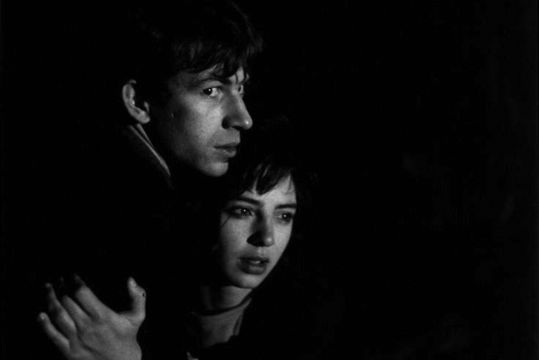
Few filmmakers can boast a body of work as audacious, beautiful or challenging as that of Pedro Costa, and Blood is one of the most extraordinary debuts of the past twenty years. Filmed in startling monochrome and demonstrating a love and knowledge of classical Hollywood and European art cinema, Blood is a lushly stylized romantic fable. It explores the plight of two brothers coming to terms with the death of their father and the legacy of violence and debt he has left behind. Languid and unsettling, beautiful and intimate, with echoes of Tourneur, Bresson, Ray and Straub-Huillet, Blood is both elusive and utterly mesmerising.
Special Features
- Presented in a new High-Definition transfer approved by the director.
- A filmed appreciation with Professor Joao Benard da Costa, author and Director of the Portuguese Cinematheque.
- New and improved English subtitle translation.
- Booklet featuring essays by author and critic Adrian Martin and journalist Frederic Bonnaud.
- Photo gallery.
- Optimal quality dual-layer disc.
Related
A short excerpt from the Booklet essay by Adrian Martin
From the very first moments of his first feature Blood (O Sangue, 1989), Pedro Costa forces us to see something new and singular in cinema, rather than something generic and familiar. The black-and-white cinematography (by Wenders compatriot Martin Schafer) in Blood pushes far beyond a fashionable effect of high contrast, and into something visionary: whites that burn, blacks that devour. Immediately, faces are disfigured, bodies deformed by this richly oneiric work on light, darkness, shadow and staging.
Carl Dreyer in Gertrud gave cinema something that Jacques Rivette (among others) celebrated: bodies that 'disappear in the splice', that live and die from shot to shot, thus pursuing a strange half-life in the interstices between reels, scenes, shots, even frames. Costa takes this poetic of light and shade, of appearance and disappearance – the poetic of Dreyer, Murnau, Tourneur – and radicalises it still further.
In Blood, there is a constant, trembling tension: when a scene ends, when a door closes, when a back is turned to camera, will the character we are looking at ever return? People disappear in the splices, a sickly father dies between scenes, transforming in an instant from speaking and (barely) breathing body to heavy corpse.
Blood is a special first feature – the first features of not-yet auteurs themselves forming a particular cinematic genre, especially in retrospect. Perhaps it was from Huillet and Straub's Class Relations that Costa learnt the priceless lesson of screen fiction, worthy of Samuel Fuller: start the piece instantly, with a gaze, a gesture, a movement, some displacement of air and energy, something dropped like a heavy stone to shatter the calm of pre-fiction equilibrium. To set the motor of the intrigue going – even if that intrigue will be so shadowy, so shrouded in questions that go to the very heart of its status as a depiction of the real. So Blood begins sharply, after the sound (under the black screen) of a car stopping, a door slamming, footsteps: a young man has his face slapped. Cut (in a stark reverse-field, down an endless road in the wilderness) to an older man, the father. Then back to the young man: "Do what you want with me." The father picks up his suitcase (insert shot) and begins to walk off … The beginning of Colossal Youth also announces, in just this way, its immortal story: bags thrown out a window, a perfect image (reminiscent, on a Surrealist plane, of the suitcases thrown into rooms through absent windows, the sign of a ceaseless moving on and moving in, in Ruiz's City of Pirates) of dispossession, of beings restlessly on the move from the moment they begin to exist in the image.
Adrian Martin's complete Essay, from which this short excerpt is taken, appears in the booklet of the DVD release


